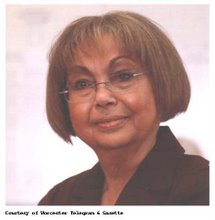
On this day in May (May 17) and on so many other days in May, I have witnessed the “crowning” of so many assistants. The assistants’ assistance, at least for me and for those like me, is indispensible to our work. We rely on the assistant’s skills for carrying out data analysis, word processing, typing draft, deciphering illegible hand writing, and above all doing the task with geniality, respect, love, and appreciation of the learning experience.
On this day in May, Clark University Economics Department graduated six new PhD’s and Seven MA’s. Over my tenure at Clark of more than 35 years I have the privilege not only of being involved in the education of our graduate students but to chair the doctoral theses of more than the number of those years. Most rewarding for me perhaps is the opportunity to work closely with so many assistants.
On this day in May, I have hosted a party to celebrate the achievements of some of our graduates. It has struck me then as it has in other occasions, that how many of our graduates were my assistants in one year or another. Some were with me for 3 or 4 years.
The celebration, which I have arranged in almost every year to follow the graduation ceremony, brings together the new graduates with some of their predecessors not only to celebrate their achievements but also to give them a taste of what await them out there. The celebration however could not be complete without my acknowledgment of the assistants’ contributions to my own scholarly achievements. Over so many years I have relied on them, worked with them and learned a great deal from them. Without the “assistant”, it would have been less pleasant for me to be my “own assistant”.
Rather than heaping on myself the praise for being their mentor and professor, I thought it is time for me, if not for all other who were privileged to have assistants to salute the “ASSISTANT”.
To all of you who worked with me as assistant at Clark University or elsewhere, I salute you. I pay you the highest regards one is able to convey. I wish you all the best.
As you depart and embark on your new carrier, remember the “Assistant”. One day you will be celebrating the “assistant’s” own accomplishments, but in doing so do not forget that in his celebration you are celebrating your own.
Good luck to the Assistant and to all graduates. Mille Merci.
Wednesday, May 20, 2009


Tuesday, November 25, 2008
The Financial Meltdown: Where were the Economists?
“Like a good novel, each phase in economic history has its villains, heroes, and defining moments. Often, it is only with hindsight that we can identify them” (Borio and Whiter, August 2003).
At The inaugural conference of the Mosakowski Institute for Public Enterprise, Clark University which took place on November 13-14, 2008, The Honorable Michel Dukakis, former Governor of Massachusetts and currently a professor of Political Science, Northeastern University, gave Clark University President’ lecture: “Reality based Leadership: Putting ideas into action”. Given that the conference theme was “University Research and the American Agenda: Discovering Knowledge, Enabling Leadership”, it was more than befitting to gain insight about leadership from someone who held a leadership position as the governor of Massachusetts for three terms.
The talk was thought provoking to put mildly. Addressing an audience of students, faculty, and administrators as well as invited conference participants, governor Dukakis spent the better part of his speech talking about his administration accomplishments. And, while doing so he saw fit to chastise the “Academy” for its complacency in addressing national needs, social as well as economics. He described the Academy’s activities as given rise to “national failure” along the line one may ascribe to the market the concept of market failure associated with public sector provision of the public good. He forcefully pointed out that the learning experience at US colleges and Universities neither prepares students to participate in the public sector arena, nor instruct them about issues that affect theirs and their fellow citizens’ lives. He reserved his harshest critique for universities’ researchers in general and economists in particular.
Alluding to the
This harsh critique is well earned. One need not agree with governor Dukakis harsh critique of the Academy to acknowledge the academic failure in not making the contributions’ of its members heard, and heard not by fellow colleagues and students but by the community at large. If there is a failure, it is not a failure in teaching or research but rather in dissemination. But dissemination of finding outside the university gates is costly, both in time and money. Communications have benefits as well as costs, and the market for dissemination of information is imperfect to say the least (more on that in a follow up blog).As an economists among others in the audience, although not particularly welcoming Governor Dukakis harsh critique of the Academy (his full remarks are posted at the Mosakowiski Institute web page), I appreciated the concern eloquently expressed for the social needs of those who have fallen out of the “social net”.
Without touting one’s horn, I have always believed and acted upon the view that education must serve the public as well as the private interest. Throughout my academic career I have been fortunate enough to carry out this task, not only as a member of the Academy but also as a participant in research institutions whose function is to disseminate information to a wide audience as well as participate if not shape debates about the nation, economic policy. Institutions like the Brookings Institution, the American Enterprise Institute are most often identified as the Academy where public debates on issues originate and information about policy impact is disseminated. Researchers in these institutions are members of those colleges and universities for whom the governor directed his criticism. The fact that faculty members do not run to the State House or the halls of Congress to testify does not mean that they do not contribute to shaping public policy or inform their fellow citizens about the merits as well as the pitfalls of such policies. One should not loose sight of the fact that the ‘Academy’ is the store of value as well as the generator of these values. A look at who is who in the public sector, how policy is formulated, aired out and sometimes “killed” paint the full picture of the Academy. Indeed today there are more institutes that you can count on hands and feet compared to forty years ago. Institutes have replaced the Academy narrowly defined as referring to colleges and universities as the instrument for effective engagement in public policy debates. This development for the most part reflects the cost of dissemination of knowledge, both the time is required for the activities and the money needed to for effective delivery. The new Mosakowski Institute is an example as to why only at that level a member of a college and or a university can be heard, as it reduces the personal cost of participation.
With my partial response to Governor Dukakis critique out of the way, a bit of economics is in order. Putting the current crisis in historical perspective, one need not go further than the Nixon era. During Nixon’s tenure (1968- 1974), the phrase was coined “we are all Keynesian now”. Keynesian economics was named after John Maynard Keynes’s The General Theory of Employment, Interest and Money (1936). The Great Depression of the 1930’s convinced the majority of economists that the emphasis on the efficiency of “unfettered” markets is misplaced. Keynes argued that the source of economic fluctuations is aggregate demand and that active stabilization policy—government tax reductions and spending increases, are needed to stabilize the economy.
In the 1960’s, there was near consensus about Keynesian economics. This consensus however faltered in 1970’s with the emergence of the “New Classical Macroeconomics”. The New Classical economists argued for replacing Keynesian economics with “Macroeconomics” theory based on market efficiency, and that it should be grounded in microeconomics, that economic agents (you and I and our company)act in the economy in our best interest i.e. optimize.
The new Classical Macroeconomics was challenged and a new stream of developed by a school of thought referred to as the “New Keynesians. The major tenets of the new theory are: that fluctuations in nominal variables like money supply influence real variables like GDP and, that economic fluctuations are the product of market imperfections such as wage and price rigidities. Theoretical developments about sources of fluctuations, how policy monetary and fiscal affect the real economy, whether governments should pursue active policy (manipulating monetary aggregates and budget posture) or follow passive policy, like Milton Friedman fixed 3% monetary rule or John Taylor interest rate rule, and so on . The macro economics landscape had become so convoluted that most economists especially those teaching the undergraduate macro, unable to inject all these new developments (often highly mathematical) in the course materials to explain the phenomenon of economic fluctuations. Those of us who taught graduate macro had to run not only to catch up with developments in the field but also to figure out which side of the debate one has to declare oneself. Macro economics was comingled with monetary economics, high power modeling and empirical analysis. The central issue of fluctuations was debated and what to do about it depended on the model of the time. In short macro economics lost its innocence. We needed to know a lot more than we did during the phase of Keynesian macro economics.
What implications had these developments for the conduct of policy? Most significant perhaps, are the proliferations of innovations that had taken place in the financial markets some of which have barely been digested in the literature and or in policy debates. Ideology about the efficiency of the market still remained supreme; hence a laissez faire attitude prevailed at least among many in the economic profession. Today financial woes may in part reflect unshaken faith in the superiority of market outcomes. What went wrong is a complicated and lengthy scenario that would require as big a volume as the General Theory (I am confident that some economist will come up with an opus magnum on it like the one by Friedman and Schwartz: Monetary History of the
Since the mid 1990’s economists have written about changes in the macro economy, especially about changes in the monetary transmission mechanism and especially about financial innovations such as securitization, the rapid growth of derivative markets and financial liberalizations.(see Federal Reserve Bank of New York Conference on monetary transmission, April 5-6, 2001, also papers in the Federal Reserve Bank of Kansas City’s Symposium on Monetary policy and Uncertainty: Adapting to a changing Economy, August 28- 30, 2003) just to name a few. Several papers dealt with the impact of financial innovations on the real economy as well as the liberalizations on the financial sector in general and the banking sectors in particular. There were many warnings of about dangers ahead but went unheeded.
The paper by Borio and White “Whither Monetary and Financial Stability? The implications of Evolving Monetary Regimes” is of particular interest. The authors make the following points:
- Financial liberalization both within and across national borders which began in the mid 1970’s were virtually completed in 1990’s. For all intent and purposes, this produced a shift from a government-led to a market- led international financial system (p.140). The result is a rise in competitive pressures and easier access to external funding.
- Advances in information technologies led to a wider spectrum of tradable instruments, in particular the rapid development of derivatives markets facilitated by the unbundling of risk into its constituent components (p. 143).
- Increased focus of Central Banks on price stability. This shift implied a grater willing to accept volatility in short run interest rate.
Their conclusion in a nutshell is that: “changes in the financial and monetary regimes may have potentially increased the scope for financial imbalances to grow during expansionary phases. This makes the economy more vulnerable to boom and bust cycles (p.149). In a liberalized financial environment, the risk of episodes of financial instability is higher than in a more controlled system. The incidence of banking crisis was much more limited during the post war, a period where the financial system was much more regulated.
From the analysis they posit that: The policy challenge would be to put in place mutually supportive safeguards in the financial and monetary spheres to insure the necessary degree of financial and monetary stability.
With policy makers being hasty to rescue and bail out the financial sector and or the beleaguered auto industry, they should take a deep breath and see where their policies fit in light of the imposing changes in the financial structure and the transmission mechanism of monetary policy. They would do well to read Borio and White’s timely analysis.
One final note: Early on I have indicated that if there is a failure at the Academy it is in the transmission of the fruits of research. I believe this view is shared by many whose research is in the public interest yet it lacked public hearings. Good news on this front. A new publication in accessible format was launched October 2008: Economists Voice, www.bepress.com/ev. The objective is to make the economist’s views on current issues, events and policy heard in a format accessible to a wide audience I applaud this effort and hope that many members of the Academy follow suit.
[1] Friedman & Schwartz, A Monetary History of The
Tuesday, April 8, 2008
“No, No, We Won’t Go”: Why Some African Presidents Refuse to Retire.
The phrase “No, No, we won’t go” was chanted back in the 1960s. It came to mind as I read a piece in the Economist (March 15-17, 2008) about debates currently taking place in Cameroon on Presidential Term limits. The title of the piece is “Another President who won’t go” (p. 49-50). The Economist reported that on February 24th and 25th violent protests broke out in Douala, Cameroon commercial capital in response to Cameroon’s President, Paul Biya’s hint that “he might stay on for a third term of another seven years.” President Biya has presided over Cameroon for 25 years. A new constitution which came into force in 1996, limits the President to only two terms. For the 75 years old President “not to go”, the constitution will have to be changed to allow him to stay.
Aside from reporting about the Mayhem that followed the President’s hint and about the weakness of the opposition parties challenging the ruling party nothing is said to enlighten readers about why the President of Cameroon won’t go. This phenomenon is not endemic to Cameroon.[1] To understand this phenomenon, the hold on power, one has to put it in the proper context.
Old men of Africa, most of whom are in their late seventies or in their eighties have ruled for over two decades. Most of these Rulers have come to power on the heel of independence with the blessing of their citizens. Having one of their own with no clear tie and in opposition to the colonial power that ruled the country was hailed by one and all. Expectations ran high. Rulers and subjects had great hopes for their countries and at the beginning it looked that way. But then the hope dashed, the expectations were not fulfilled. What went wrong?
To be “scientific” one need to examine a country by country experience. This clearly is not the place. Two excellent books. “The Fate of Africa, From the Hopes of Freedom to the Heart of Despair: A History of 50 years of Independence” (2005) by Martin Meredith and “A Continent for the Taking: The Tragedy and Hope of Africa” (2004) by Howard W. French provide a clear picture and documentation of many a tragedy.
In this space what may be instructive is to show that the “hold” on power is to be expected. Data compiled by Banks[2] gives information on the ruler’s tenure for almost all countries in the world over the period 1815-1999. When this data is combined with the Freedom House rating of freedom over the period 1973-2006 (a range from 1 to 7: 1 is free and 7 is not free) a clear picture emerges. Consider the following nine African countries: Botswana, Cameroon, Ghana, Kenya, Mauritius, Mozambique, South Africa, Uganda and Zimbabwe. Botswana is rated as FREE with a score of 2.0; since 1980 it had two turnover of rulers. Cameroon has a rating of 6.0 (not free) with one turnover of power since 1980; Ghana gets the FREE label (score 1.5) with two turnover of tenure in 1981, 1984 although no change in tenure for 1990-1999. Kenya as classified as partly free with a score of (3.0) although it shows no change in tenure since 1978. Mauritius id FREE with 2.0 score and since 1980 had experienced two turnovers in rulers, in 1982 and in 1999. Mozambique is given the score of 3.5 as partly free with turnover in 1986, but no change in the period 1990-1999. South Africa gets a score of (2.0) with three turnovers over the period 1980-1999. Uganda is classified as partly free (4.5) with no turnover in ruler’s tenure over the period 1990-1999 although it shows four changes from 1980-1989. Zimbabwe had one change in 1980 and Mugabe’s tenure is 28 years and counting.
These examples highlight one of the fundamentals behind the “no go” phenomenon. FREEDOM with all its ramifications is the most significant factor in determining the staying power of a ruler. Freedom is much more than simply conducting an election. It involves the guarantee of political rights (electoral process, political pluralism, and participation) and civil liberties (free and independent media, freedom of assembly and open public discussion, rule of law and individual rights). Few of these rights have been met in many Sub-Saharan Africa countries despite the fact that elections are held, opposition parties participate but the outcome somehow is seen to be preordained. The present Ruler either “win” not “fairly” and squarely the opposition either attacked, silenced or jailed (see Howard French).
One needs to give details about what goes on before and during an election many African countries. There is a saying that “power corrupts”. This is true when one looks at executive tenure in undemocratic regimes as well as in some of the world democracies. The election for the office of President in the US, runs in the billions and more often than not it costs the contender millions of dollars in out-pocket, (not to mention the wear and tear the candidate undergo). Look no further than the rate of return on the investment reaped by Presidents and ex-Presidents. This return is much valued when a ruler is transformed from the status of an ordinary citizen with modest means to the status of a “mogul” with the nation’s wealth under his/her sole control. It is ironic that the Governors and ex-Governors would show no indignation at the outright “abuse” and “blunder” of the wealth by a ruler in a state where the phrase “no, no we won’t go” is heard. Exposing this abuse by insisting that the “net worth” of a ruler be revealed for his/her admission in the world community would go a long way in changing the behavior of those rulers who wouldn’t go.
[1] Remember what happened in the presidential election in Kenya and now it is Robert Mugabe of Zimbabwe to orchestrate a win in the run off election for President.
[2] Cross-National Time-Series Data Archive, Copyright (c) 2001 Arthur S. Banks.
Aside from reporting about the Mayhem that followed the President’s hint and about the weakness of the opposition parties challenging the ruling party nothing is said to enlighten readers about why the President of Cameroon won’t go. This phenomenon is not endemic to Cameroon.[1] To understand this phenomenon, the hold on power, one has to put it in the proper context.
Old men of Africa, most of whom are in their late seventies or in their eighties have ruled for over two decades. Most of these Rulers have come to power on the heel of independence with the blessing of their citizens. Having one of their own with no clear tie and in opposition to the colonial power that ruled the country was hailed by one and all. Expectations ran high. Rulers and subjects had great hopes for their countries and at the beginning it looked that way. But then the hope dashed, the expectations were not fulfilled. What went wrong?
To be “scientific” one need to examine a country by country experience. This clearly is not the place. Two excellent books. “The Fate of Africa, From the Hopes of Freedom to the Heart of Despair: A History of 50 years of Independence” (2005) by Martin Meredith and “A Continent for the Taking: The Tragedy and Hope of Africa” (2004) by Howard W. French provide a clear picture and documentation of many a tragedy.
In this space what may be instructive is to show that the “hold” on power is to be expected. Data compiled by Banks[2] gives information on the ruler’s tenure for almost all countries in the world over the period 1815-1999. When this data is combined with the Freedom House rating of freedom over the period 1973-2006 (a range from 1 to 7: 1 is free and 7 is not free) a clear picture emerges. Consider the following nine African countries: Botswana, Cameroon, Ghana, Kenya, Mauritius, Mozambique, South Africa, Uganda and Zimbabwe. Botswana is rated as FREE with a score of 2.0; since 1980 it had two turnover of rulers. Cameroon has a rating of 6.0 (not free) with one turnover of power since 1980; Ghana gets the FREE label (score 1.5) with two turnover of tenure in 1981, 1984 although no change in tenure for 1990-1999. Kenya as classified as partly free with a score of (3.0) although it shows no change in tenure since 1978. Mauritius id FREE with 2.0 score and since 1980 had experienced two turnovers in rulers, in 1982 and in 1999. Mozambique is given the score of 3.5 as partly free with turnover in 1986, but no change in the period 1990-1999. South Africa gets a score of (2.0) with three turnovers over the period 1980-1999. Uganda is classified as partly free (4.5) with no turnover in ruler’s tenure over the period 1990-1999 although it shows four changes from 1980-1989. Zimbabwe had one change in 1980 and Mugabe’s tenure is 28 years and counting.
These examples highlight one of the fundamentals behind the “no go” phenomenon. FREEDOM with all its ramifications is the most significant factor in determining the staying power of a ruler. Freedom is much more than simply conducting an election. It involves the guarantee of political rights (electoral process, political pluralism, and participation) and civil liberties (free and independent media, freedom of assembly and open public discussion, rule of law and individual rights). Few of these rights have been met in many Sub-Saharan Africa countries despite the fact that elections are held, opposition parties participate but the outcome somehow is seen to be preordained. The present Ruler either “win” not “fairly” and squarely the opposition either attacked, silenced or jailed (see Howard French).
One needs to give details about what goes on before and during an election many African countries. There is a saying that “power corrupts”. This is true when one looks at executive tenure in undemocratic regimes as well as in some of the world democracies. The election for the office of President in the US, runs in the billions and more often than not it costs the contender millions of dollars in out-pocket, (not to mention the wear and tear the candidate undergo). Look no further than the rate of return on the investment reaped by Presidents and ex-Presidents. This return is much valued when a ruler is transformed from the status of an ordinary citizen with modest means to the status of a “mogul” with the nation’s wealth under his/her sole control. It is ironic that the Governors and ex-Governors would show no indignation at the outright “abuse” and “blunder” of the wealth by a ruler in a state where the phrase “no, no we won’t go” is heard. Exposing this abuse by insisting that the “net worth” of a ruler be revealed for his/her admission in the world community would go a long way in changing the behavior of those rulers who wouldn’t go.
[1] Remember what happened in the presidential election in Kenya and now it is Robert Mugabe of Zimbabwe to orchestrate a win in the run off election for President.
[2] Cross-National Time-Series Data Archive, Copyright (c) 2001 Arthur S. Banks.
Tuesday, March 25, 2008
The Biggest Dilemma: How to Reduce America Health Care Costs and “Ensure” An Affordable High Quality Health Care for All?
The Biggest Dilemma: How to Reduce America Health Care Costs and “Ensure” An Affordable High Quality Health Care for All?
This blog is not written to enter the debate currently been waged in the Presidential race between Senators Obama and Clinton about their respective health plans. Rather, the purpose is to raise some issues that have been overlooked in both plans.
The Obama webpage gives a well “researched” outline of his plan: “Barak Obama’s plan for A Healthy America” www.barakobama.com/issues/healthcare/ (number of pages 14). I say well researched judging by the number of references (65) used as documentation. To an economist’s eye, especially those of us who at one time or another engaged in research and analysis of the delivery of health care in the US and the UK, the piece is a scholarly one.[1]
The Clinton plan: “The American Health Choices Plan: Ensuring Quality, Affordable Health Care for All Americans,” (www.hillaryclinton.com/feature/healthcareplan/Americanhealthcarechoicesplan.pdp) is an 11- page write up with 21 references. But unlike the Obama’s plan, Clinton backs up some of the plan provisions with data supporting the financial needs for health reform (p.11). The estimates are welcomed not only because they make scrutiny of the plan easier but also they shed light on the credibility of the proposal. The plan gives detailed provisions that if implemented would secure for the American people the elusive universal coverage and the quality of care that we all hope for but we seldom encounter.
As both plans are accessible with a click of the mouse, I shall not reproduce here all of their features. What I will attempt to do is to put the main features of both plans in the context of the current status of American health care system and raise few questions that are left unanswered. Let me first begin with a few statistics. [2]
· The US spends some 2 trillion dollars per year on medical care (US Consensus Bureau Health 2007). This amounts to $6,644 per capita.
· There are 46 million Americans who lack health insurance coverage (of which 9.7 million are children) (National Health Expenditures 2007).
· Over the period 2000-2006 Health Insurance premiums have risen four times more than wages (Kaiser Family Foundation 2006).
· 90,000 Patients die from medical errors in hospitals every year.[3]
· Spending on preventative care amount to less than 4 percent of health care spending. (Lambrew, J.M. The Hamilton Project Brookings 2007).
· Administrative costs as a percent of medical expenditures amount to 27% of Medicare/Medicaid and 16% of private insurance (The Prometheus Fact book/Health use).
· One in six uninsured person lives in a family with an increase between $50,000 and $75,000 (Ibid).
· Per capita health care cost in the US is twice as high as that of Canada, France, and Japan and 2.6 times that in the UK (OECD Health Statistics).
These statistics paint a picture not unfamiliar to Americans. Almost every one knows that we spend a significant proportion of gross national income on medical care (14.44 % in 2007), that patients die in hospitals due to errors, that nursing homes residents are abused more often than not, that malpractice suits are prevalent and costly and that health insurance premiums, deductibles and the cost of drug therapy and testing are rising much faster than the core inflation rate and/or the wage rate. Yet, there has not been sufficient indignation over the status of the US health care system to compel policy makers to address rising cost, the lack of universal coverage and most of all the “quality” of health care. Some of this may be explained by the fact that physicians and patients as well as the public at large, for the most part are convinced that universal medical care coverage would lead to nationalization of the health care system (a la British and the Canadian systems), a system that would limit medical care resources and constraint patient choices.
In this election cycle, something seems to be happening on the health care front. Interest in the Presidential race, especially the selection of the Democratic Party nominee has opened a window for the candidates to press for universal health coverage. The hope is that voters’ interests in a candidate can propel him/her to secure their support for a universal health plan.
Since health care is at the top of the Democratic candidates agenda, let us focus on what they offer, what their plans have in common and where they differ.
· Coverage: expand insurance coverage to the uninsured. Private insurers would be required to offer policies to everyone, regardless of medical history.
· Choice: offer all Americans an enhanced choice in the selection of insurance coverage through a mix of private and public plans including the Federal Employees Health Benefit Program (FEHBP).
· Affordability: make insurance affordable to low-income Americans.
· Quality: improve quality through monitoring of services and modernizing the system.
These salient features notwithstanding the “devil” is in the details. Take coverage for example: Hillary Clinton envisages a system that offers coverage for all (universal coverage), achieved by mandating that everyone have insurance. The question of affordability comes later. Barack Obama does not see the need for mandates (although he mandates coverage for children) on the ground that by making the plan affordable, the uninsured will buy coverage. This clearly is a point of contention not only between the candidates but also among health economists (see Krugman, P., NY times, op. Ed. March 4, 2008). The bottom line seem to be: if you want universal coverage, mandates is the way to go. Making insurance affordable does not guarantee purchase.
The question that arises is: “if insurance is affordable, why wouldn’t the uninsured buy coverage?” The answer is simple. Why buy coverage if there is a “third party payer”. Currently some uninsured persons receive medical care through the “uncompensated care pool”. Insurance companies shift the cost of providing this care to those who buy insurance by raising their premium. The same is true for auto insurance (it is estimated that 14% of drivers do not buy insurance). Despite the mandates, most auto insurance plans include provisions (with additional premium) to cover damages by uninsured motorists. The bottom line then is that mandates may not assure universal coverage but it is likely to reduce the cost to third party payers compared with a plan without mandates.
Aside from mandates, Clinton envisages a health care system that is not too different from the existing system…a private/public system, although the plan may end up expanding the public component if many Americans (currently insured and the uninsured) move to opt for coverage under the Federal Employee Health Benefit plan (FEHBP).[4] The Obama plan favors a bigger role for the government in the medical care market through the creation of a “new public insurance program” offered to those who neither qualify for Medicaid or SCHI, nor covered by employers’ plans. His plan also calls for a “National Health Insurance Exchange.” This organization is envisaged to be a ‘watchdog’ for the private insurance market protecting those who want to buy. Insurance and facilitates enrollment in the newly established public plan.
Reading the lines and between the lines, it is clear that the Obama plan comes down on the side of public provision. The question is: will there be one public plan or several like those offered by FEHBP? And what agency will administer the plan? Will it be part of the HHS department or an independent agency? And what is the cost of administration and who bears the additional costs? Above all, why the need for a new public plan given that the Obama health plan also calls for extending FEHBP to non-government employees?
Two fundamental elements not adequately addressee in both Obama and Clinton plans had to do with “measurements of health outcomes” and the phenomenon of “cost shifting”. ‘Quality’ needs to be defined in terms of “long term outcomes” and in relation to cost, monetary and time costs across generations. In talking about quality neither plan gave adequate attention to patients “waiting time”, “quality of access” (which doctor, procedure or hospital), and to “medical errors” committed by physicians, radiologists and hospitals (even though some of these errors carry with them monetary payments through ‘malpractice suits’). What about access to catastrophic insurance and quality of access to nursing homes. Another related issue is the status of those covered by Medicare. Will Medicare subscribers have the option to opt out of Medicare (part B) and join another plan, especially in view of the fact that the Medicare premium paid is progressive (rises with income) and for most Medicare beneficiary private insurance is needed to supplement medical coverage?
We have gone down this road before (several reform proposals made in the 1980s and the 1990s). Two options are usually debated. Keeping the private/public mix but change this or that provision or junk the system and nationalize (one payer) medical care. Past experience suggests that a private/public system is the preferred system. Piece meal changes are the way to go. There is nothing wrong with this approach as long as the contemplated reform ushers in at least one improvement. No one denies that there are many elements that need fixing in the US Health care system. Let us hope that reforming America health care system gets a fair hearing and not falls by the wayside once the presidential election comes to a close.
[1] Ott A. and Gray W. The Massachusetts Health Pan: The Right Perception? (1988).
Ott A. Choice and Incentives in Health Care: A Comparison between the US and the UK (two conference papers, Institute for Economic Studies (IEPS), Clark University and the University of York, UK).
Ott and Lin J.H. Equality of Access to Health Care: A Comparison of the US and UK systems (1986), IEPS.
[2] Some of these Statistics are cited in Obama’s plan.
[3] As Dennis Cortes, President and CEO of Mayo Clinic puts it “this is the equivalent of two 747 planes crashing every two days”. Talk covered by CSPAN 2, March 21, 2008.
[4] Although FEHBP is a Federal government program, it does not entail public provision of services. FEHBP offers federal employees some 10 plans such as Blue Cross/Blue Shield with different levels of premiums, contributions, benefits and deductibles. It differs from private employers plans in the level of government contribution towards the purchase of the chosen plan. For details see: US Office of Personnel Management webpage.
This blog is not written to enter the debate currently been waged in the Presidential race between Senators Obama and Clinton about their respective health plans. Rather, the purpose is to raise some issues that have been overlooked in both plans.
The Obama webpage gives a well “researched” outline of his plan: “Barak Obama’s plan for A Healthy America” www.barakobama.com/issues/healthcare/ (number of pages 14). I say well researched judging by the number of references (65) used as documentation. To an economist’s eye, especially those of us who at one time or another engaged in research and analysis of the delivery of health care in the US and the UK, the piece is a scholarly one.[1]
The Clinton plan: “The American Health Choices Plan: Ensuring Quality, Affordable Health Care for All Americans,” (www.hillaryclinton.com/feature/healthcareplan/Americanhealthcarechoicesplan.pdp) is an 11- page write up with 21 references. But unlike the Obama’s plan, Clinton backs up some of the plan provisions with data supporting the financial needs for health reform (p.11). The estimates are welcomed not only because they make scrutiny of the plan easier but also they shed light on the credibility of the proposal. The plan gives detailed provisions that if implemented would secure for the American people the elusive universal coverage and the quality of care that we all hope for but we seldom encounter.
As both plans are accessible with a click of the mouse, I shall not reproduce here all of their features. What I will attempt to do is to put the main features of both plans in the context of the current status of American health care system and raise few questions that are left unanswered. Let me first begin with a few statistics. [2]
· The US spends some 2 trillion dollars per year on medical care (US Consensus Bureau Health 2007). This amounts to $6,644 per capita.
· There are 46 million Americans who lack health insurance coverage (of which 9.7 million are children) (National Health Expenditures 2007).
· Over the period 2000-2006 Health Insurance premiums have risen four times more than wages (Kaiser Family Foundation 2006).
· 90,000 Patients die from medical errors in hospitals every year.[3]
· Spending on preventative care amount to less than 4 percent of health care spending. (Lambrew, J.M. The Hamilton Project Brookings 2007).
· Administrative costs as a percent of medical expenditures amount to 27% of Medicare/Medicaid and 16% of private insurance (The Prometheus Fact book/Health use).
· One in six uninsured person lives in a family with an increase between $50,000 and $75,000 (Ibid).
· Per capita health care cost in the US is twice as high as that of Canada, France, and Japan and 2.6 times that in the UK (OECD Health Statistics).
These statistics paint a picture not unfamiliar to Americans. Almost every one knows that we spend a significant proportion of gross national income on medical care (14.44 % in 2007), that patients die in hospitals due to errors, that nursing homes residents are abused more often than not, that malpractice suits are prevalent and costly and that health insurance premiums, deductibles and the cost of drug therapy and testing are rising much faster than the core inflation rate and/or the wage rate. Yet, there has not been sufficient indignation over the status of the US health care system to compel policy makers to address rising cost, the lack of universal coverage and most of all the “quality” of health care. Some of this may be explained by the fact that physicians and patients as well as the public at large, for the most part are convinced that universal medical care coverage would lead to nationalization of the health care system (a la British and the Canadian systems), a system that would limit medical care resources and constraint patient choices.
In this election cycle, something seems to be happening on the health care front. Interest in the Presidential race, especially the selection of the Democratic Party nominee has opened a window for the candidates to press for universal health coverage. The hope is that voters’ interests in a candidate can propel him/her to secure their support for a universal health plan.
Since health care is at the top of the Democratic candidates agenda, let us focus on what they offer, what their plans have in common and where they differ.
· Coverage: expand insurance coverage to the uninsured. Private insurers would be required to offer policies to everyone, regardless of medical history.
· Choice: offer all Americans an enhanced choice in the selection of insurance coverage through a mix of private and public plans including the Federal Employees Health Benefit Program (FEHBP).
· Affordability: make insurance affordable to low-income Americans.
· Quality: improve quality through monitoring of services and modernizing the system.
These salient features notwithstanding the “devil” is in the details. Take coverage for example: Hillary Clinton envisages a system that offers coverage for all (universal coverage), achieved by mandating that everyone have insurance. The question of affordability comes later. Barack Obama does not see the need for mandates (although he mandates coverage for children) on the ground that by making the plan affordable, the uninsured will buy coverage. This clearly is a point of contention not only between the candidates but also among health economists (see Krugman, P., NY times, op. Ed. March 4, 2008). The bottom line seem to be: if you want universal coverage, mandates is the way to go. Making insurance affordable does not guarantee purchase.
The question that arises is: “if insurance is affordable, why wouldn’t the uninsured buy coverage?” The answer is simple. Why buy coverage if there is a “third party payer”. Currently some uninsured persons receive medical care through the “uncompensated care pool”. Insurance companies shift the cost of providing this care to those who buy insurance by raising their premium. The same is true for auto insurance (it is estimated that 14% of drivers do not buy insurance). Despite the mandates, most auto insurance plans include provisions (with additional premium) to cover damages by uninsured motorists. The bottom line then is that mandates may not assure universal coverage but it is likely to reduce the cost to third party payers compared with a plan without mandates.
Aside from mandates, Clinton envisages a health care system that is not too different from the existing system…a private/public system, although the plan may end up expanding the public component if many Americans (currently insured and the uninsured) move to opt for coverage under the Federal Employee Health Benefit plan (FEHBP).[4] The Obama plan favors a bigger role for the government in the medical care market through the creation of a “new public insurance program” offered to those who neither qualify for Medicaid or SCHI, nor covered by employers’ plans. His plan also calls for a “National Health Insurance Exchange.” This organization is envisaged to be a ‘watchdog’ for the private insurance market protecting those who want to buy. Insurance and facilitates enrollment in the newly established public plan.
Reading the lines and between the lines, it is clear that the Obama plan comes down on the side of public provision. The question is: will there be one public plan or several like those offered by FEHBP? And what agency will administer the plan? Will it be part of the HHS department or an independent agency? And what is the cost of administration and who bears the additional costs? Above all, why the need for a new public plan given that the Obama health plan also calls for extending FEHBP to non-government employees?
Two fundamental elements not adequately addressee in both Obama and Clinton plans had to do with “measurements of health outcomes” and the phenomenon of “cost shifting”. ‘Quality’ needs to be defined in terms of “long term outcomes” and in relation to cost, monetary and time costs across generations. In talking about quality neither plan gave adequate attention to patients “waiting time”, “quality of access” (which doctor, procedure or hospital), and to “medical errors” committed by physicians, radiologists and hospitals (even though some of these errors carry with them monetary payments through ‘malpractice suits’). What about access to catastrophic insurance and quality of access to nursing homes. Another related issue is the status of those covered by Medicare. Will Medicare subscribers have the option to opt out of Medicare (part B) and join another plan, especially in view of the fact that the Medicare premium paid is progressive (rises with income) and for most Medicare beneficiary private insurance is needed to supplement medical coverage?
We have gone down this road before (several reform proposals made in the 1980s and the 1990s). Two options are usually debated. Keeping the private/public mix but change this or that provision or junk the system and nationalize (one payer) medical care. Past experience suggests that a private/public system is the preferred system. Piece meal changes are the way to go. There is nothing wrong with this approach as long as the contemplated reform ushers in at least one improvement. No one denies that there are many elements that need fixing in the US Health care system. Let us hope that reforming America health care system gets a fair hearing and not falls by the wayside once the presidential election comes to a close.
[1] Ott A. and Gray W. The Massachusetts Health Pan: The Right Perception? (1988).
Ott A. Choice and Incentives in Health Care: A Comparison between the US and the UK (two conference papers, Institute for Economic Studies (IEPS), Clark University and the University of York, UK).
Ott and Lin J.H. Equality of Access to Health Care: A Comparison of the US and UK systems (1986), IEPS.
[2] Some of these Statistics are cited in Obama’s plan.
[3] As Dennis Cortes, President and CEO of Mayo Clinic puts it “this is the equivalent of two 747 planes crashing every two days”. Talk covered by CSPAN 2, March 21, 2008.
[4] Although FEHBP is a Federal government program, it does not entail public provision of services. FEHBP offers federal employees some 10 plans such as Blue Cross/Blue Shield with different levels of premiums, contributions, benefits and deductibles. It differs from private employers plans in the level of government contribution towards the purchase of the chosen plan. For details see: US Office of Personnel Management webpage.
Monday, February 25, 2008
Good News for Africa: Another Day, Another Gain
In my last blog “Why do Governments Engage in Mass Killing, February 18”, I wished Kenyans well in their strive for democracy and restoration of their faith in democracy. Wishes sometimes come true. The Wall Street Journal (Friday February 22), brought the good news.
According to the associated press: “Kenya’s government tentatively agreed to create a Prime Minister’s post to be filled by the opposition moving the East African country a step closer to ending weeks of deadly clashes over the disputed presidential election” (p. A8). In my piece, I wished for a sharing of power, which would ultimately lead to the restoration of the presidential office to the true winner. In the meantime, this sharing of power may be enough to assure Kenyan citizens that their democracy is not fragile, that it will endure. A sad note accompanying this good news, is that the ‘ethnic grievances and violence have left more than 1000 people dead”. Kenya violent conflict unfortunately, has put it in the book as given rise to Mass Killings (see http://attiatott.blogspot.com/ February 18, 2008 for definition of mass killing).
Over the past two years, we at the Institute for Economic Policy Studies have made efforts albeit modest, given our volunteerism efforts and our own resources (no outside support) to put forth the idea that developing ‘human resources’ should be at the forefront in the design, execution and funding for development. Education is and should be the building block for improving the economic conditions for the people. The development strategy often has been devoted to bricks and motors, not to human development or the right human development. It is not enough to throw money on education infrastructure (aside of the fact of being minuscule, compared to other infrastructures), rather it is much more important to ‘know’ how to make use of education infrastructure. Africa may surely lack education infrastructure but they surely have educators who can if challenged and channeled properly effect development.
The title of my piece today, Another Day, Another Gain was motivated by President Bush recent announcement. (Two Routes to Building Africa: Bush Visit (to Liberia) Emphasizes Human Development; Wall Street Journal, February 22, p.A8). US and Western powers are urged to focus more on human development. President Bush went further by announcing that the “US will provide one million text books for Liberia in the next year.” Clearly a step in the right direction. One may ask what text books and for what educational level: elementary, secondary or tertiary? The paper did not say. I am sure the details are now being worked out at the Agency for International Development.
It is a good step no matter what books or at what level. I have been taught that all books no matter how bad are good books in that they will make you think, they will make you see and feel what otherwise could not have been seen or felt and that what education is all about.
I have always wondered about what to do with the surplus of books many of us in Academia, especially those of us with long carriers, who will no longer have needs of these books. Even in the age of the internet there is still something about the wholesomeness of books. Hopefully, the President’s effort of building the reading capacity of Liberia’s people would extend beyond text books, and by opening the door for all who have books to channel these books to Africa would be users, he will indeed have succeeded in promoting knowledge, a vehicle often overlooked as the first building block for development.
Some of my former PhD students in Economics and myself are educators. We believe that education and the use of educators generated knowledge have been overlooked by development institutions, universities and donors. To that end, the Institute for Economic Policy Studies is sponsoring a conference to address this issue. We are encouraged by the President statements. Perhaps the day has finally come to put development on a sound footing.
According to the associated press: “Kenya’s government tentatively agreed to create a Prime Minister’s post to be filled by the opposition moving the East African country a step closer to ending weeks of deadly clashes over the disputed presidential election” (p. A8). In my piece, I wished for a sharing of power, which would ultimately lead to the restoration of the presidential office to the true winner. In the meantime, this sharing of power may be enough to assure Kenyan citizens that their democracy is not fragile, that it will endure. A sad note accompanying this good news, is that the ‘ethnic grievances and violence have left more than 1000 people dead”. Kenya violent conflict unfortunately, has put it in the book as given rise to Mass Killings (see http://attiatott.blogspot.com/ February 18, 2008 for definition of mass killing).
Over the past two years, we at the Institute for Economic Policy Studies have made efforts albeit modest, given our volunteerism efforts and our own resources (no outside support) to put forth the idea that developing ‘human resources’ should be at the forefront in the design, execution and funding for development. Education is and should be the building block for improving the economic conditions for the people. The development strategy often has been devoted to bricks and motors, not to human development or the right human development. It is not enough to throw money on education infrastructure (aside of the fact of being minuscule, compared to other infrastructures), rather it is much more important to ‘know’ how to make use of education infrastructure. Africa may surely lack education infrastructure but they surely have educators who can if challenged and channeled properly effect development.
The title of my piece today, Another Day, Another Gain was motivated by President Bush recent announcement. (Two Routes to Building Africa: Bush Visit (to Liberia) Emphasizes Human Development; Wall Street Journal, February 22, p.A8). US and Western powers are urged to focus more on human development. President Bush went further by announcing that the “US will provide one million text books for Liberia in the next year.” Clearly a step in the right direction. One may ask what text books and for what educational level: elementary, secondary or tertiary? The paper did not say. I am sure the details are now being worked out at the Agency for International Development.
It is a good step no matter what books or at what level. I have been taught that all books no matter how bad are good books in that they will make you think, they will make you see and feel what otherwise could not have been seen or felt and that what education is all about.
I have always wondered about what to do with the surplus of books many of us in Academia, especially those of us with long carriers, who will no longer have needs of these books. Even in the age of the internet there is still something about the wholesomeness of books. Hopefully, the President’s effort of building the reading capacity of Liberia’s people would extend beyond text books, and by opening the door for all who have books to channel these books to Africa would be users, he will indeed have succeeded in promoting knowledge, a vehicle often overlooked as the first building block for development.
Some of my former PhD students in Economics and myself are educators. We believe that education and the use of educators generated knowledge have been overlooked by development institutions, universities and donors. To that end, the Institute for Economic Policy Studies is sponsoring a conference to address this issue. We are encouraged by the President statements. Perhaps the day has finally come to put development on a sound footing.
Monday, February 18, 2008
Why do governments engage in civilian killings?
In a paper published in the Journal of Defense and Peace Economics (2008, vol. 19(2)) by colleague Sang Hoo Bae and Attiat F. Ott, we have investigated theoretically and empirically the predatory behavior of government: the case of mass killing. As such journal papers go; the model and the empirical analysis are not for general consumption. Nonetheless, the story it tells is not difficult to follow and the conclusions it arrives at is worth highlighting.
Before I summarize our findings, I need to acknowledge a contribution to this topic made by Hugo Slim in his book: Killing Civilians: Method, Madness and Morality of War (Colombia University Press, 2008), reviewed by the Economist (February 16th, 2008, p.92). Although I have yet to read the book, the Economist’s review touches on a few of the issues we have addressed on our paper on mass killing. Our findings may go some way to answer the basic question raised: why kill civilians? Let me begin by citing few relevant statistics.
In the 20th century there were 109.7 million civilian killings by the state. This amounted to 4.35% of world population. In the 19th century, these were 19.4 million deaths or 1.65% of the world population, an increase of over 500 percent. According to the World Development Report 2005, most of the violent conflicts leading to civilian killings took place in low income developing countries, with 38% of these taking place in Africa.
Violent conflicts leading to mass killings of civilians fall into three categories: military conflict between states; between states and non-state groups; and between factions within a state. When we talk about civil war we are referring to the third category commonly referred to as “intra state” war. In this type, either the state (government) or a rebel group is the initiator. Examples of civil war include Angola civil war lasting 27 years with more than one million deaths, repeated wars in Sri Lanka with 500,000 deaths, Rwanda with over a million death to name a few. Mr. Slim gave reasons for civilian death including “a desire to exterminate an entire group of purportedly inferior beings; a lust for power and domination, necessity or plunder”, (The Economist, p.92). A student of violent conflicts especially civil wars can find not one but many causes for killing civilians. Sang Hoo Bae and myself being economists, we explain mass killings by the state by modeling the choice of a ruler of a country in which there are two distinct groups of populations (divided along ethnic, religion or other elements) by characterizing the decision as a three stage process. We investigate the ruler’s (assumed belonging to one group) options: engage in mass killings of the other group (initiate civil war); resolve the conflict by forming a coalition government; or do nothing.
Think of the current civil war in Kenya that started following the December 27 presidential elections. The ruler, President Mawai Kibaki is said to have lost the election to the opposition but refused to relinquish to Daila Odinga the presidency. The ruler, Mawai Kibaki options are those we have investigated in our paper. Our model solves for the optimal choice. We show that which option the ruler will choose depends on the “probability to remain in office which is derived from his political power; on the expected wealth from attacking the opposition group and the cost of the attack.” The cost can be of two types: military expenditures and cost of outside sanctions. In the Kenyan case, the flurry of activities by outsiders (the non-state group) including the US secretary of state, the former UN Secretary General, Kofi Annan may raise the cost and might tilt the choice towards a coalition government.
Using data on civilian mass killings over the period 1816 – 1997, we attempted to identify those factors that accounted for the choice of the mass killing option. But what mass killing constitutes? And who compile the data? The data is derived from the Correlates of War (COW) project. COW gives information on conflicts with more than 1000 battle related deaths. In the conflict studies, 1000 battle related deaths have been taken to signify mass killing. In our study we use this number and also redo the statistical analysis with 10,000 battle related deaths as defining a mass killing episode.
The statistical results of testing our model for the civilian mass killing that occurred between 1816 and 1997 give insight into the question raised earlier: the ruler’s choice of mass killing or as a Mr. Slim has put it: why kill civilians? Our findings reveal that “the length of executive tenure (how long the ruler held the office) plays a very significant role in civil war killings. In addition, it identified ethnicity, as a contributing factor, in that the “more fragmented the population – many ethnic groups – the less likely is mass killing and vice versa”. The results that were not unexpected had to do with spending on the military conflict and the income of the country. High military spending increases the probability of killings; the second the higher the income of the country the less likely the ruler is to engage in civilian mass killing.
The civil war in Kenya will hopefully come to an end before it belongs to the COW records where the civilian death rate reaches 1000. It would be a tragedy not only for the civilian population who are paying a heavy price for democracy but also for the world at large. The international community should persuade, cajole even compensate (bribe?) the ruler to restore democracy by opting for the power sharing arrangement for a limited period (to save face) and to restore the presidential office to the opposition if it turned out that Mr. Odinga was indeed the true winner.
Before I summarize our findings, I need to acknowledge a contribution to this topic made by Hugo Slim in his book: Killing Civilians: Method, Madness and Morality of War (Colombia University Press, 2008), reviewed by the Economist (February 16th, 2008, p.92). Although I have yet to read the book, the Economist’s review touches on a few of the issues we have addressed on our paper on mass killing. Our findings may go some way to answer the basic question raised: why kill civilians? Let me begin by citing few relevant statistics.
In the 20th century there were 109.7 million civilian killings by the state. This amounted to 4.35% of world population. In the 19th century, these were 19.4 million deaths or 1.65% of the world population, an increase of over 500 percent. According to the World Development Report 2005, most of the violent conflicts leading to civilian killings took place in low income developing countries, with 38% of these taking place in Africa.
Violent conflicts leading to mass killings of civilians fall into three categories: military conflict between states; between states and non-state groups; and between factions within a state. When we talk about civil war we are referring to the third category commonly referred to as “intra state” war. In this type, either the state (government) or a rebel group is the initiator. Examples of civil war include Angola civil war lasting 27 years with more than one million deaths, repeated wars in Sri Lanka with 500,000 deaths, Rwanda with over a million death to name a few. Mr. Slim gave reasons for civilian death including “a desire to exterminate an entire group of purportedly inferior beings; a lust for power and domination, necessity or plunder”, (The Economist, p.92). A student of violent conflicts especially civil wars can find not one but many causes for killing civilians. Sang Hoo Bae and myself being economists, we explain mass killings by the state by modeling the choice of a ruler of a country in which there are two distinct groups of populations (divided along ethnic, religion or other elements) by characterizing the decision as a three stage process. We investigate the ruler’s (assumed belonging to one group) options: engage in mass killings of the other group (initiate civil war); resolve the conflict by forming a coalition government; or do nothing.
Think of the current civil war in Kenya that started following the December 27 presidential elections. The ruler, President Mawai Kibaki is said to have lost the election to the opposition but refused to relinquish to Daila Odinga the presidency. The ruler, Mawai Kibaki options are those we have investigated in our paper. Our model solves for the optimal choice. We show that which option the ruler will choose depends on the “probability to remain in office which is derived from his political power; on the expected wealth from attacking the opposition group and the cost of the attack.” The cost can be of two types: military expenditures and cost of outside sanctions. In the Kenyan case, the flurry of activities by outsiders (the non-state group) including the US secretary of state, the former UN Secretary General, Kofi Annan may raise the cost and might tilt the choice towards a coalition government.
Using data on civilian mass killings over the period 1816 – 1997, we attempted to identify those factors that accounted for the choice of the mass killing option. But what mass killing constitutes? And who compile the data? The data is derived from the Correlates of War (COW) project. COW gives information on conflicts with more than 1000 battle related deaths. In the conflict studies, 1000 battle related deaths have been taken to signify mass killing. In our study we use this number and also redo the statistical analysis with 10,000 battle related deaths as defining a mass killing episode.
The statistical results of testing our model for the civilian mass killing that occurred between 1816 and 1997 give insight into the question raised earlier: the ruler’s choice of mass killing or as a Mr. Slim has put it: why kill civilians? Our findings reveal that “the length of executive tenure (how long the ruler held the office) plays a very significant role in civil war killings. In addition, it identified ethnicity, as a contributing factor, in that the “more fragmented the population – many ethnic groups – the less likely is mass killing and vice versa”. The results that were not unexpected had to do with spending on the military conflict and the income of the country. High military spending increases the probability of killings; the second the higher the income of the country the less likely the ruler is to engage in civilian mass killing.
The civil war in Kenya will hopefully come to an end before it belongs to the COW records where the civilian death rate reaches 1000. It would be a tragedy not only for the civilian population who are paying a heavy price for democracy but also for the world at large. The international community should persuade, cajole even compensate (bribe?) the ruler to restore democracy by opting for the power sharing arrangement for a limited period (to save face) and to restore the presidential office to the opposition if it turned out that Mr. Odinga was indeed the true winner.
Monday, October 29, 2007
WILL MONEY SOLVE AFRICA’S DEVELOPMENT PROBLEMS?
“Ask a foolish question and you will get a foolish answer”. These words by Nobel Laureate Milton Freidman echoed in my mind as I read a piece in the African Executive (10/22/2007) under the banner “Will Money Solve Africa’s Development Problems?”
Few days later, the same question appeared in The Economist (October 27th) as an advertisement by the John Templeton Foundation. The African Executive’s piece gave snips of the conversations with eight (8) “leading Scientists and scholars” sponsored by the Templeton Foundation. Responses to the query were as follows: Five (NO); One definite (YES); Two are conditional. The full statements appear at the Foundation Web page.
The essays are quite short, and reflect as one might expect the background and or affiliation of the author. Whether the answer to the question can be put in the positive or negative column, the insight one gains from the response tell a great deal about the author’s own experience in the field of development. Without getting bogged down in the nitty-gritty of what is being said, let me focus on few issues highlighted in the essays.
First: The glaring indictment of “aid”. “Donner nations have spent billions of dollars for development schemes in post colonial Africa, yet there is little to show for this beyond dependency and corruption” (Edward Green); “After fifty years of trying and $600 billions worth of aid- giving, with close to zero rise in living standards in Africa, I can make the case for NO pretty decisively” (William Easterly); “Africa does not need aid from governments and international agencies” (James Tooley).
Second: Africa does not lack money or resources. “The problem in Africa has never been lack of money, but rather the inability to exploit the African Mind (HALALUWA) -- If money was key to solving the problems, banks would send agents in the streets to supply money to afflicted individuals” (They actually do, but this is another issue) (James Shikwati).
Third: Money does not create Wealth. “Big money to Africa – empowers bureaucracies, promotes statism, and weakens government incentives to increase tax revenues through economic growth” (Iqbal Z. Quadir).
True enough. If moneys treated as a consumption good — a pay off to corrupt politicians and institutions, it not only have a zero return to providers, but also waste precious resource by diverting them to conspicuous consumption which most often give rise to social and political unrest.
Let me turn briefly to the Friedman quote. Money can take a number of forms. It can be “fiat” money created by the Central Banks and governments This money creation, increasing the supply of domestic money does not add to resources, in effect it heats up an economy and destroys incentives and long term planning .Money In the Templeton Conversations obviously does not refer to a nation’s domestic supply. Think of it as outside money or more accurately a supply of real resources from countries other than the recipient countries. Put differently, the money affects a transfer of real resources from the donor’s country to the recipient country. The transfer of resources is the “wealth added”, it is the attributes of Money as an instrument for wealth creation.
The question then that needed to be posed at the outset is “In What Form Will IT BE GIVEN?” That is in the form of AID, or LOANS? Most of the conversations seem to revolve about money given in the form of aid. Easterly along with few others have questioned the values of foreign aid given by governments or international institutions. Others, notably Sachs, do not agree. Without getting bogged down into the nuances of this debate the appropriate question to ask perhaps should have been: “WHAT CONTRIBUTION AID WILL MAKE TO WARDS ECONOMIC DEVELOPMENT OF THE AFRICAN CONTINENT?” This question would have focused the discussion on the one aspect of development, namely economic growth and secondly gave respondents a way to assess based on their experiences the use to which aid resources were invested or dissipated. Conversations with scholars and practitioners should not leave the uninitiated with the feeling that all is lost that aid giving has no place in the arsenal against poverty and helplessness. Evaluating Aid relative to loans and foreign direct investment would have given the reader something to think in terms of the efficiency of instruments aimed at spurring economic development in the African continent.
If one were to think of economic development as an outcome to a process, then for every outcome or output there are inputs. Students in ECON 101 learned (hopefully) that to produce positive output requires certain levels of inputs — that output requires the combining of factors: labor, physical capital and know-how. Money given to a country in the form of aid simply adds to these factors if took the form of physical capital or know-how. So how the resource is given matter and not by whom it is given or by whom it is received. One need not forget that Aid add to resources without the requirement that a positive rate of return must be secured in the short or immediate run whereas loans and direct foreign investment require expectation of returns sufficiently high to both service the debt and in the case of foreign investment an after risk positive return. It is unquestionably true that augmenting a country’s resources through foreign aid, as long as not all of it was dissipated through remittances made by corrupt governments to their accounts outside the country, will increase the national output and employment. Let us not forget that economic development requires marshalling of resources, especially capital and know how. Irrespective of how corrupt are government and institutions in an African country the mere exposure to “FRESH AIR” called it the global economy improves its chances for economic development.
One needs to remember in conversation like the one initiated by the Templeton Foundation that DEVELOPMENT is multifaceted, not only economics but social , cultural and political also. To address African development problems let us first enumerate these problems and sort out those that our existing repertoire of knowledge can solve and those that require investment to acquire new knowledge. Second, it may be useful to prioritize developments objectives. Some form of ranking will help in assessing the efficiency of allocation in relation to expectations. In some cases investing extra resources has a measured outcome (access to clean water by every household), in other cases such as returns to good governance or ethnic tolerance may not have ones
The Templeton Foundation has embarked on a mission that hopefully will foster an understanding and not only the dialogue between citizens in the NORTH and the SOUTH. Expanding the base of knowledge is a conduit for problem solving. People and their knowledge matter. Through knowledge wealth is created. Access to knowledge is a prerequisite for not only creating wealth but for knowing how best to use it.
A final remark: It is gratifying to see in some of the responses to the Templeton Foundation question that the resource most in need of development in Africa is the “MIND” (see “Africa development needs development of the mind beyond the University’s border” at http://attiatott.blogspot.com/, March 22, 2007). Mr Quadir puts it best: “The time has come for us to stop pouring billions of dollars into bureaucracies. Instead we must cultivate the billion brains in Africa”.
How to develop the African’ mind? To that end The Institute for Economic Policy Studies will host a conference with the collaboration of the University of Botswana (at the University of Botswana in August 2008). The conference theme: “Developing a Continent: Who is in Charge?” Details will be posted at the Institute web site and by contacting Professor Lecha at the University of Botswana.
Few days later, the same question appeared in The Economist (October 27th) as an advertisement by the John Templeton Foundation. The African Executive’s piece gave snips of the conversations with eight (8) “leading Scientists and scholars” sponsored by the Templeton Foundation. Responses to the query were as follows: Five (NO); One definite (YES); Two are conditional. The full statements appear at the Foundation Web page.
The essays are quite short, and reflect as one might expect the background and or affiliation of the author. Whether the answer to the question can be put in the positive or negative column, the insight one gains from the response tell a great deal about the author’s own experience in the field of development. Without getting bogged down in the nitty-gritty of what is being said, let me focus on few issues highlighted in the essays.
First: The glaring indictment of “aid”. “Donner nations have spent billions of dollars for development schemes in post colonial Africa, yet there is little to show for this beyond dependency and corruption” (Edward Green); “After fifty years of trying and $600 billions worth of aid- giving, with close to zero rise in living standards in Africa, I can make the case for NO pretty decisively” (William Easterly); “Africa does not need aid from governments and international agencies” (James Tooley).
Second: Africa does not lack money or resources. “The problem in Africa has never been lack of money, but rather the inability to exploit the African Mind (HALALUWA) -- If money was key to solving the problems, banks would send agents in the streets to supply money to afflicted individuals” (They actually do, but this is another issue) (James Shikwati).
Third: Money does not create Wealth. “Big money to Africa – empowers bureaucracies, promotes statism, and weakens government incentives to increase tax revenues through economic growth” (Iqbal Z. Quadir).
True enough. If moneys treated as a consumption good — a pay off to corrupt politicians and institutions, it not only have a zero return to providers, but also waste precious resource by diverting them to conspicuous consumption which most often give rise to social and political unrest.
Let me turn briefly to the Friedman quote. Money can take a number of forms. It can be “fiat” money created by the Central Banks and governments This money creation, increasing the supply of domestic money does not add to resources, in effect it heats up an economy and destroys incentives and long term planning .Money In the Templeton Conversations obviously does not refer to a nation’s domestic supply. Think of it as outside money or more accurately a supply of real resources from countries other than the recipient countries. Put differently, the money affects a transfer of real resources from the donor’s country to the recipient country. The transfer of resources is the “wealth added”, it is the attributes of Money as an instrument for wealth creation.
The question then that needed to be posed at the outset is “In What Form Will IT BE GIVEN?” That is in the form of AID, or LOANS? Most of the conversations seem to revolve about money given in the form of aid. Easterly along with few others have questioned the values of foreign aid given by governments or international institutions. Others, notably Sachs, do not agree. Without getting bogged down into the nuances of this debate the appropriate question to ask perhaps should have been: “WHAT CONTRIBUTION AID WILL MAKE TO WARDS ECONOMIC DEVELOPMENT OF THE AFRICAN CONTINENT?” This question would have focused the discussion on the one aspect of development, namely economic growth and secondly gave respondents a way to assess based on their experiences the use to which aid resources were invested or dissipated. Conversations with scholars and practitioners should not leave the uninitiated with the feeling that all is lost that aid giving has no place in the arsenal against poverty and helplessness. Evaluating Aid relative to loans and foreign direct investment would have given the reader something to think in terms of the efficiency of instruments aimed at spurring economic development in the African continent.
If one were to think of economic development as an outcome to a process, then for every outcome or output there are inputs. Students in ECON 101 learned (hopefully) that to produce positive output requires certain levels of inputs — that output requires the combining of factors: labor, physical capital and know-how. Money given to a country in the form of aid simply adds to these factors if took the form of physical capital or know-how. So how the resource is given matter and not by whom it is given or by whom it is received. One need not forget that Aid add to resources without the requirement that a positive rate of return must be secured in the short or immediate run whereas loans and direct foreign investment require expectation of returns sufficiently high to both service the debt and in the case of foreign investment an after risk positive return. It is unquestionably true that augmenting a country’s resources through foreign aid, as long as not all of it was dissipated through remittances made by corrupt governments to their accounts outside the country, will increase the national output and employment. Let us not forget that economic development requires marshalling of resources, especially capital and know how. Irrespective of how corrupt are government and institutions in an African country the mere exposure to “FRESH AIR” called it the global economy improves its chances for economic development.
One needs to remember in conversation like the one initiated by the Templeton Foundation that DEVELOPMENT is multifaceted, not only economics but social , cultural and political also. To address African development problems let us first enumerate these problems and sort out those that our existing repertoire of knowledge can solve and those that require investment to acquire new knowledge. Second, it may be useful to prioritize developments objectives. Some form of ranking will help in assessing the efficiency of allocation in relation to expectations. In some cases investing extra resources has a measured outcome (access to clean water by every household), in other cases such as returns to good governance or ethnic tolerance may not have ones
The Templeton Foundation has embarked on a mission that hopefully will foster an understanding and not only the dialogue between citizens in the NORTH and the SOUTH. Expanding the base of knowledge is a conduit for problem solving. People and their knowledge matter. Through knowledge wealth is created. Access to knowledge is a prerequisite for not only creating wealth but for knowing how best to use it.
A final remark: It is gratifying to see in some of the responses to the Templeton Foundation question that the resource most in need of development in Africa is the “MIND” (see “Africa development needs development of the mind beyond the University’s border” at http://attiatott.blogspot.com/, March 22, 2007). Mr Quadir puts it best: “The time has come for us to stop pouring billions of dollars into bureaucracies. Instead we must cultivate the billion brains in Africa”.
How to develop the African’ mind? To that end The Institute for Economic Policy Studies will host a conference with the collaboration of the University of Botswana (at the University of Botswana in August 2008). The conference theme: “Developing a Continent: Who is in Charge?” Details will be posted at the Institute web site and by contacting Professor Lecha at the University of Botswana.
Wednesday, September 12, 2007
A Marshall Plan for Sub-Saharan Africa; A Common Market for East Africa; Star Power for Africa; A Zero Hand Out Approach in Africa
These are but a few examples of what has become the most fashionable approach to rid oneself of guilt over the plight of those less fortunate than ourselves. The rich and famous, rich and not so famous, have discovered Africa, a discovery that warrant applause as well as critical evaluation.
Africa is a continent which for long has been labeled the “dark” continent. Since Dr. Levingston put a foot there in search of the source of the Nile, the world has looked upon Africa as some place out there one visits either to take home a “trophy” animal or mineral or to boost of being the first to claim a territory for “God and Country”. The scramble for African territory which began at the end of the 19th century gave European powers virtually the entire continent. All that remained was the division of spoils. At meetings in Berlin, Paris and London, European statesmen bargained over spheres of influences and traded lands and peoples to secure the desired outcome. “When marking out the boundaries of their new territories, European negotiators frequently resorted to drawing straight lines on the map, taking little or no account of the myriad of traditional monarchies, chiefdoms and other African societies that existed on the ground” (Martin Meredith, 2005, p.1). Africans for the most part were spectators. Those who opposed or resisted colonial rule died in battle, executed or shipped out to fight in European battles. No territory in Africa except Ethiopia escaped colonial rule. Africa emerged from the 19th century scramble, a continent divided with its people segmented according to the powers that have been there. There was British Africa, French Africa, Dutch Africa, Belgian Africa, Portuguese Africa, Italian Africa, as well as Arabian Africa. The haggling in Europe was over African territory with little attention to people – their ethnic identity, history or religion. Land and people were little more than pieces on a chess board.
As the world awoken to embrace through benevolent or violent acts the liberal order, people even in the Dark Continent were entitled to “life, liberty and pursuit of happiness”. Africa in the 21st century became theater for social experiments. Some would say it has become a playground for the rich and famous, the rich and not so famous. Africa also has become a theater for war among African themselves, poor and rich, between governments and those they govern.
Several scholarly books and hundreds of articles in scholarly journals have been written about Africa. A devastating assessment of the “goings on” in Africa since independence is given in two volumes: “A continent for the taking: The tragedy and hope of Africa” by Edward French (Alfred A. Knopt, 2004), and “The fate of Africa: From the hopes of freedom to the heart of despair” by Martin Meredith (Public Affairs, 2005).
The scramble for Africa in this century mimics the scramble for Africa at the end of the nineteenth century. Back then, European powers staked claims to Africa resources human and physical, in this twenty first century the scramble for Africa is not for men and gems (although that is true too) but for prestige and publicity. As Mandela’s wife, activist Graça Machel, the former first lady of Mozambique, has put it “what is uniformly true about celebrities is that they get attention for themselves, to some extent, but also for the issues they choose to highlight” (quotation from The Christian Science Monitor, August 22, 2007, p.11).
As the title of this piece suggests, there are several approaches to aid Africa. Scholars like Deepak and Raja Patirana examined the contribution of aid to Africa (it is the largest for any region, averaging 6.3 percent of GDP for all Africa, excluding South Africa and Nigeria, compared to 1 percent to South Asia and 0.3 percent to Latin America and the Caribbean). In their article “The Triumph of Hope Over Experience: A Marshall Plan for Sub-Saharan Africa?” (American Enterprise Institute, August 2007), Deepak and Raja Patirana discussed whether such a program, proposed by British Prime Minister Gordon Brown, is a viable alternative to current aid policies. Although most of the discussion is devoted to a comparison between the preexisting conditions in Europe and the current conditions in Sub-Saharan Africa, a prerequisite for assessment of such a program, the conclusion that emerges is that “European Marshall Plan and post-independence aid to Africa were responses to entirely different situations, so drawing parallels between the two is not justified” (p.3).
Africa statesmen (East African heads of state) offer an alternative to aid “a common market and a single currency for East Africa by 2012”*, again fashioned along the successful European experience.
A departure from aid and trade is “self help” or “a zero hand out approach in Africa” (The Christian Science Monitor, September 5, 2007). The idea behind this approach is capacity building and local control. A US based charity “Care for Life” reports success in promoting self reliant as a development strategy. All to the good, but one data point does not make a statistic.
Let me now focus on the “glamorous” approach to African development. A question that needed to be asked was put forth by a Tanzanian columnist, Ayah Rioba, a day after Bill Clinton visit to Africa: “is this really how to save Africa?” (quoted in the The Christian Science Monitor, August 23, 2007). Good question.
There are as many schools of thoughts about how to help Africa as there are clients and/or reformers. Leaving the academic debate aside for now, a subject for a later piece, the celebrities’ approach to development is a novel one that deserves the economists’ attention (at least this economist). Unlike academicians (except perhaps in the case of Jeffrey Sachs and the staff of the Agency for International Development), celebrities peddle glamour, beauty, riches to a captivated audience.
To gauge effectiveness of celebrities’ actions, let us first look at how celebrities have “carved” Africa among themselves. The Christian Science Monitor has devoted several issues (in August) tracking celebrities path into Africa: Bill Clinton: South Africa, Malawi, Zambia and Tanzania; Mia Farrow: Rwanda, Chad and Darfur; Madonna: Malawi; Oprah Winfrey: South Africa; and, of course, Angelina Jolie everywhere there are refugees as the United Nations High Commissioner for Refugees Spokeswoman. Unlike the European scramble for Africa in the 19th century, the celebrities scramble is far from complete. Why not say Burkina Faso, The Gambia, Guinea Bissau, Mali, Congo or Cameroon to list a few. One wonders how do African in these HIPCs Sub-Saharian countries feel about celebrities “neglect”**. There are 33 countries in Sub-Saharan Africa classified as HIPCs with per capita income of less than $2 per day. South Africa which has attracted celebrities’ attention is not one of them. One also ponders celebrities’ choice.
Pondering these questions is par for the course for an economist. In economics 101, one lays out the landscape of choice – examine the options available and the constraints faced in order to evaluate the choice outcome. The market is the place where such information is gained. Unfortunately, there is no market parallel for examining and/or evaluating celebrities choice, and their aid to Africa. Although one may speculate as to why South Africa was chosen and not the Gambia, it may perhaps be more useful in this instance to reverse the process – from the outcome back to the choice. Oprah Winfrey built a “Leadership School” in South Africa; The Counsel of Elders was initiated to address conflict resolution; the Clinton-Hunter development initiative aimed to expand access to water, sanitation, health care and agricultural markets in Malawi and Rwanda; the Clinton foundation works in 69 developing countries on initiatives ranging from expanding access to HIV/AIDS medication to reducing big cities greenhouse-gas emissions. These are but fragments about outcomes gained from newspapers accounts. From this information one could say that the choice of the country reflects the donor’s own perspective on Africa or on a particular cause he/she likes to advance. These outcomes notwithstanding what is missing is a true accounting of aid effectiveness – what is used to be called the “bang for the buck”. This accounting may hopefully be forthcoming soon. Bruce Sievers, a visiting scholar at Stanford University, is writing a book about the development of philanthropy. He is quoted as saying that for celebrities the bang of the buck is high in Africa (The Christian Science Monitor, August 22, 2007, p.11). But hopefully he can show that this is true as well for Africans.
* Bill Gates, Bono and economist Jeffrey Sachs share Brown in calling for a Marshal Plan for Africa and for a vast increase in aid. An analysis of the Marshall Plan and the common market proposals will be taken up in follow-up pieces.
**See August 2, 2007, blog for HIPCs definition.
Africa is a continent which for long has been labeled the “dark” continent. Since Dr. Levingston put a foot there in search of the source of the Nile, the world has looked upon Africa as some place out there one visits either to take home a “trophy” animal or mineral or to boost of being the first to claim a territory for “God and Country”. The scramble for African territory which began at the end of the 19th century gave European powers virtually the entire continent. All that remained was the division of spoils. At meetings in Berlin, Paris and London, European statesmen bargained over spheres of influences and traded lands and peoples to secure the desired outcome. “When marking out the boundaries of their new territories, European negotiators frequently resorted to drawing straight lines on the map, taking little or no account of the myriad of traditional monarchies, chiefdoms and other African societies that existed on the ground” (Martin Meredith, 2005, p.1). Africans for the most part were spectators. Those who opposed or resisted colonial rule died in battle, executed or shipped out to fight in European battles. No territory in Africa except Ethiopia escaped colonial rule. Africa emerged from the 19th century scramble, a continent divided with its people segmented according to the powers that have been there. There was British Africa, French Africa, Dutch Africa, Belgian Africa, Portuguese Africa, Italian Africa, as well as Arabian Africa. The haggling in Europe was over African territory with little attention to people – their ethnic identity, history or religion. Land and people were little more than pieces on a chess board.
As the world awoken to embrace through benevolent or violent acts the liberal order, people even in the Dark Continent were entitled to “life, liberty and pursuit of happiness”. Africa in the 21st century became theater for social experiments. Some would say it has become a playground for the rich and famous, the rich and not so famous. Africa also has become a theater for war among African themselves, poor and rich, between governments and those they govern.
Several scholarly books and hundreds of articles in scholarly journals have been written about Africa. A devastating assessment of the “goings on” in Africa since independence is given in two volumes: “A continent for the taking: The tragedy and hope of Africa” by Edward French (Alfred A. Knopt, 2004), and “The fate of Africa: From the hopes of freedom to the heart of despair” by Martin Meredith (Public Affairs, 2005).
The scramble for Africa in this century mimics the scramble for Africa at the end of the nineteenth century. Back then, European powers staked claims to Africa resources human and physical, in this twenty first century the scramble for Africa is not for men and gems (although that is true too) but for prestige and publicity. As Mandela’s wife, activist Graça Machel, the former first lady of Mozambique, has put it “what is uniformly true about celebrities is that they get attention for themselves, to some extent, but also for the issues they choose to highlight” (quotation from The Christian Science Monitor, August 22, 2007, p.11).
As the title of this piece suggests, there are several approaches to aid Africa. Scholars like Deepak and Raja Patirana examined the contribution of aid to Africa (it is the largest for any region, averaging 6.3 percent of GDP for all Africa, excluding South Africa and Nigeria, compared to 1 percent to South Asia and 0.3 percent to Latin America and the Caribbean). In their article “The Triumph of Hope Over Experience: A Marshall Plan for Sub-Saharan Africa?” (American Enterprise Institute, August 2007), Deepak and Raja Patirana discussed whether such a program, proposed by British Prime Minister Gordon Brown, is a viable alternative to current aid policies. Although most of the discussion is devoted to a comparison between the preexisting conditions in Europe and the current conditions in Sub-Saharan Africa, a prerequisite for assessment of such a program, the conclusion that emerges is that “European Marshall Plan and post-independence aid to Africa were responses to entirely different situations, so drawing parallels between the two is not justified” (p.3).
Africa statesmen (East African heads of state) offer an alternative to aid “a common market and a single currency for East Africa by 2012”*, again fashioned along the successful European experience.
A departure from aid and trade is “self help” or “a zero hand out approach in Africa” (The Christian Science Monitor, September 5, 2007). The idea behind this approach is capacity building and local control. A US based charity “Care for Life” reports success in promoting self reliant as a development strategy. All to the good, but one data point does not make a statistic.
Let me now focus on the “glamorous” approach to African development. A question that needed to be asked was put forth by a Tanzanian columnist, Ayah Rioba, a day after Bill Clinton visit to Africa: “is this really how to save Africa?” (quoted in the The Christian Science Monitor, August 23, 2007). Good question.
There are as many schools of thoughts about how to help Africa as there are clients and/or reformers. Leaving the academic debate aside for now, a subject for a later piece, the celebrities’ approach to development is a novel one that deserves the economists’ attention (at least this economist). Unlike academicians (except perhaps in the case of Jeffrey Sachs and the staff of the Agency for International Development), celebrities peddle glamour, beauty, riches to a captivated audience.
To gauge effectiveness of celebrities’ actions, let us first look at how celebrities have “carved” Africa among themselves. The Christian Science Monitor has devoted several issues (in August) tracking celebrities path into Africa: Bill Clinton: South Africa, Malawi, Zambia and Tanzania; Mia Farrow: Rwanda, Chad and Darfur; Madonna: Malawi; Oprah Winfrey: South Africa; and, of course, Angelina Jolie everywhere there are refugees as the United Nations High Commissioner for Refugees Spokeswoman. Unlike the European scramble for Africa in the 19th century, the celebrities scramble is far from complete. Why not say Burkina Faso, The Gambia, Guinea Bissau, Mali, Congo or Cameroon to list a few. One wonders how do African in these HIPCs Sub-Saharian countries feel about celebrities “neglect”**. There are 33 countries in Sub-Saharan Africa classified as HIPCs with per capita income of less than $2 per day. South Africa which has attracted celebrities’ attention is not one of them. One also ponders celebrities’ choice.
Pondering these questions is par for the course for an economist. In economics 101, one lays out the landscape of choice – examine the options available and the constraints faced in order to evaluate the choice outcome. The market is the place where such information is gained. Unfortunately, there is no market parallel for examining and/or evaluating celebrities choice, and their aid to Africa. Although one may speculate as to why South Africa was chosen and not the Gambia, it may perhaps be more useful in this instance to reverse the process – from the outcome back to the choice. Oprah Winfrey built a “Leadership School” in South Africa; The Counsel of Elders was initiated to address conflict resolution; the Clinton-Hunter development initiative aimed to expand access to water, sanitation, health care and agricultural markets in Malawi and Rwanda; the Clinton foundation works in 69 developing countries on initiatives ranging from expanding access to HIV/AIDS medication to reducing big cities greenhouse-gas emissions. These are but fragments about outcomes gained from newspapers accounts. From this information one could say that the choice of the country reflects the donor’s own perspective on Africa or on a particular cause he/she likes to advance. These outcomes notwithstanding what is missing is a true accounting of aid effectiveness – what is used to be called the “bang for the buck”. This accounting may hopefully be forthcoming soon. Bruce Sievers, a visiting scholar at Stanford University, is writing a book about the development of philanthropy. He is quoted as saying that for celebrities the bang of the buck is high in Africa (The Christian Science Monitor, August 22, 2007, p.11). But hopefully he can show that this is true as well for Africans.
* Bill Gates, Bono and economist Jeffrey Sachs share Brown in calling for a Marshal Plan for Africa and for a vast increase in aid. An analysis of the Marshall Plan and the common market proposals will be taken up in follow-up pieces.
**See August 2, 2007, blog for HIPCs definition.
Tuesday, August 7, 2007
What Africa needs now is benign neglect
The new Millennium was welcomed not only with fanfare and fireworks but also with renewed sense of obligation, hope and good will towards those less fortunate countries of the world. Foremost among these countries are the so called HIPCs (for definitions and other info see my blog, August 2). As the majority of the HIPCs are located in Africa, 33 countries out of 41 as classified by the World Bank, the spotlight in the new Millennium was placed on
But the Millennium also spotlighted a dark picture of
The news about
In the past two weeks, few articles on
The second article, an OP piece written by Mr. Uzodinma Iweala also appeared in The Christian Science Monitor, July 24th with the title “ An African Plea: No More Saviors”(p.9).
My first reaction as I read the title of Mr.Iweala’s piece is that he did not care much about the “elders” initiative, I did harbor the same thought myself. But then as I read the article, I found a lot more to his chagrin than what a group of “elders”, free agents with no political responsibilities hope to do for Africans. In his article Mr. Iweala articulated (based on my interactions with scholars from Africa) what many African felt the way African are presented in the Media; about slogans, to quote Mr. Iweala, such as “ Save Darfur”, “Keep a child alive/ I am African”, and white men painting the I am “African on their white skins”.
A more damaging indictment of those would be “SAVIORS”, is Mr. Iweala’s contention that the saviors campaign smack of colonial ideology. In his words “Such campaigns, however well intentioned, promote the stereotype of
Sympathy with the sentiments expressed by Mr. Iweala’s aside there is no denying the fact that many countries in the African continent are in a much worse shape today than shortly after independence ( see Martin Meredith “ The Fate of Africa: from the Hopes of Freedom to the Heart of Despair ” NY, Public Affairs 2005). But there are also success stories, countries like
Perhaps donors, policy makers, movie stars as well as ordinary citizens are over eager in showing that they do care about
Thursday, August 2, 2007
TOO LITTLE OR TOO MUCH: THE G-8 SUMMIT 2007 DECLARATION, Growth and Responsibility in Africa
“If you are interested in helping the poor, it makes sense for the developed world to forgive the debt, and that is what the United States will continue to do”. President Bush Speech to the Group of 8 (June 6-8, Heleigendamm, Germany).
At least for the past 10 years or so, at the summit meeting of the G 7-8 pledges are heard, commitments declared to help the poor, heavily indebted poor countries referred to as HIPCs rid themselves of the debt overhang, improve their living standards and achieve a sustainable rate of economic growth. The problem that is yet to be solved is how exactly these excellent goals are to be achieved. Good intentions aside, concrete measures need to be taken to lift HIPCs out of poverty and achieve a sustainable level of economic growth. One can use an example of a sick patient seeking relief. Prescription drugs or therapy require good diagnosis. This may not always be the case. Even in the best “milieu” diagnoses can err, drug therapy may not be followed or disrupted. Treating a patient with multiple illness is difficult enough, treating a country suffering from a multiple of diseases may border on the impossible.
To gain insight into the problems facing HIPCs and to evaluate the efforts exerted on their behalf, both in actuality and through pledges and pronouncements, a few statistics may be helpful. But first, who are those countries that are labeled HIPCs?
According to the World Bank, there are some 41 countries classified as HIPCs, 33 of which are in sub Sahara Africa (Angola, Benin, Burkina Faso, Burundi, Cameroon, Chad, Cote D’Ivoire, Democratic Republic of Congo, Eritrea, Ethiopia, Ghana, the Gambia, Guinea, Guinea–Bissau, Kenya, Lesotho, Liberia, Madagascar, Malawi, Mali, Mauritania, Mozambique, Niger, Republic of Congo, Rwanda, Senegal, Serra Leone, Somalia, Sudan, Tanzania, Uganda, Zambia, Zimbabwe). Non-African countries in the HIPCs group are mostly in Latin America.
The classification is based on three criteria: being poor with per capita income of less than $695 per annum, a present value of external debt to GDP ratio greater than 80%, a ratio of present value of external debt to exports greater than 220%.
To appreciate the enormity of the problems facing HIPCs and the efforts of the international community in addressing the debt issue one needs to look at the development of some of these indicators. For example, in all HIPCs, the external debt stock was at least twice the value of exports on average during the 1992-94 with several countries having ratios that exceeded 1000%. The present value of the debt service to exports was over 25%. The debt has grown so rapidly so that by 1995 (the eve of HIPC initiative), it stood at $406 billion or 9 times its value in 1970. As of 2004, the debt stock stood at $441 billion. The debt service which was equal to $1.8 billion in 1970 reached $35.7 billion in 2004 (the external debt consists of multilateral credits, official bilateral credits and private credits).
The call for debt relief (debt write-downs) for this group of countries came to fruition in the mid 1990’swhen the HIPC initiative was launched by the IMF and the World Bank. Earlier commitments towards debt relief were announced during the 1987 G-7 Summit in Venice, the 1988 G-7 Summit in Toronto where a menu of options, including partial forgiveness, lower interest rates to help poor countries meet their debt obligations. Additional debt relief measures were announced in subsequent Summits: the 1990 Houston Summit, and the 1991 London Summit. The Paris Club (the club of official lenders) also called for additional relief both in 1993 and 1994.
These waves of debt relief, from Venice to London were not sufficient to deal with the external debt problem of HIPCs. Thus, the HIPC Initiative was born. The initiative was put in place in 1996 and expanded in 1999. The initiative is a comprehensive program aimed at achieving “long term debt sustainability and poverty reduction”. But to be eligible a country must meet certain criteria such as a track record of macroeconomic policy that promote economic growth. The HIPC Initiative was supplemented in June 2005 at the G-8 meeting by a new program — the Multilateral debt Relief Initiative (MDRI). The program proposed that the three multinational Institutions, the IMF, the World Bank, and the African Development Fund, “cancel 100%” of their debt claims on these countries thus freeing their resources for development. Countries eligibilities for this program are spelled out in terms of completion of certain requirements under the HIPC Initiative. MDRI’s goal is to half the poverty rate by the year 2015.
Too Much or too Little? Whatever judgment one makes about the debt relief efforts, the debt problem of HIPCs and their poverty status had changed but little (for more details on this see W. Easterly “How Did Heavily Indebted Poor Countries Became Heavily Indebted? Reviewing Two Decades of Debt Relief’, World Development, 2002).
With all these expended efforts, what did the G-8 Summit has to offer? One interesting development is the group focus on Africa. This as it should be since the majority of HIPCs are Located in the African Continent.
“Today we underline once again our strong interest in a stable, democratic and prosperous Africa. We stress our firm resolve to implement the commitments on development made in Gleneagles (the 2005 Summit meeting). These include the historic Multilateral debt relief of up to $60 billion; increasing ODA (official development aid) to Africa by $25 billion a year by 2010.” With that the group of 8 made a number (63) of pronouncements and recommendations to improve African countries governance, Stability and developments (see Summit Declaration, June 2007). A short sample is given below:
- Good Governance in Africa is vital to Peace, Stability, Sustainable development and Growth. The G-8, with its Africa action plan, has provided a strategic framework for partnership based cooperation.
- The G-8 reaffirm their commitments to actively support countries that implement sound policies with the recommendation of the APRM (African Peer Review Mechanism).
- The G-8 reaffirm its support for infrastructure Consortium for Africa to address infrastructure shortcomings.
- The G-8 will support national and regional efforts to improve the investment climate by means of regulatory and administrative reform.
- The G-8 reiterate their commitment to education for all.
Good intentions may not always bring good outcomes. And wishing it does not make it so. No one doubts the good intentions that underlie the G-8 measures to promote sustainable development in Africa. Unfortunately a lot is wished for and little has been accomplished.
Debt relief like drug therapy is futile for a patient who lacks incentives to follow the prescribed treatment. No one belittle, or should belittle, the enormity of the problems facing the HIPCs. But, prescribing remedies may be necessary but not sufficient to secure good health outcomes. The same should be applied to HIPCs. Outcomes should be the criteria for extending debt relief or any other forms of aid. Multinational creditors should not set multiple tasks or grandiose schemes for eligibility, nor follow a protracted program of relief. As Easterly (2002) has argued: “a once and for all program is superior to a gradual program of increasing relief”. The once and for all program has to establish a credible policy that debt relief will only be given to governments with a shift in development orientation. IT MAY BE EASIER SAID THAN DONE. NEVERTHLESS IT SHOULD BE TRIED. NOTHING VENTURED, NOTHING GAINED.
At least for the past 10 years or so, at the summit meeting of the G 7-8 pledges are heard, commitments declared to help the poor, heavily indebted poor countries referred to as HIPCs rid themselves of the debt overhang, improve their living standards and achieve a sustainable rate of economic growth. The problem that is yet to be solved is how exactly these excellent goals are to be achieved. Good intentions aside, concrete measures need to be taken to lift HIPCs out of poverty and achieve a sustainable level of economic growth. One can use an example of a sick patient seeking relief. Prescription drugs or therapy require good diagnosis. This may not always be the case. Even in the best “milieu” diagnoses can err, drug therapy may not be followed or disrupted. Treating a patient with multiple illness is difficult enough, treating a country suffering from a multiple of diseases may border on the impossible.
To gain insight into the problems facing HIPCs and to evaluate the efforts exerted on their behalf, both in actuality and through pledges and pronouncements, a few statistics may be helpful. But first, who are those countries that are labeled HIPCs?
According to the World Bank, there are some 41 countries classified as HIPCs, 33 of which are in sub Sahara Africa (Angola, Benin, Burkina Faso, Burundi, Cameroon, Chad, Cote D’Ivoire, Democratic Republic of Congo, Eritrea, Ethiopia, Ghana, the Gambia, Guinea, Guinea–Bissau, Kenya, Lesotho, Liberia, Madagascar, Malawi, Mali, Mauritania, Mozambique, Niger, Republic of Congo, Rwanda, Senegal, Serra Leone, Somalia, Sudan, Tanzania, Uganda, Zambia, Zimbabwe). Non-African countries in the HIPCs group are mostly in Latin America.
The classification is based on three criteria: being poor with per capita income of less than $695 per annum, a present value of external debt to GDP ratio greater than 80%, a ratio of present value of external debt to exports greater than 220%.
To appreciate the enormity of the problems facing HIPCs and the efforts of the international community in addressing the debt issue one needs to look at the development of some of these indicators. For example, in all HIPCs, the external debt stock was at least twice the value of exports on average during the 1992-94 with several countries having ratios that exceeded 1000%. The present value of the debt service to exports was over 25%. The debt has grown so rapidly so that by 1995 (the eve of HIPC initiative), it stood at $406 billion or 9 times its value in 1970. As of 2004, the debt stock stood at $441 billion. The debt service which was equal to $1.8 billion in 1970 reached $35.7 billion in 2004 (the external debt consists of multilateral credits, official bilateral credits and private credits).
The call for debt relief (debt write-downs) for this group of countries came to fruition in the mid 1990’swhen the HIPC initiative was launched by the IMF and the World Bank. Earlier commitments towards debt relief were announced during the 1987 G-7 Summit in Venice, the 1988 G-7 Summit in Toronto where a menu of options, including partial forgiveness, lower interest rates to help poor countries meet their debt obligations. Additional debt relief measures were announced in subsequent Summits: the 1990 Houston Summit, and the 1991 London Summit. The Paris Club (the club of official lenders) also called for additional relief both in 1993 and 1994.
These waves of debt relief, from Venice to London were not sufficient to deal with the external debt problem of HIPCs. Thus, the HIPC Initiative was born. The initiative was put in place in 1996 and expanded in 1999. The initiative is a comprehensive program aimed at achieving “long term debt sustainability and poverty reduction”. But to be eligible a country must meet certain criteria such as a track record of macroeconomic policy that promote economic growth. The HIPC Initiative was supplemented in June 2005 at the G-8 meeting by a new program — the Multilateral debt Relief Initiative (MDRI). The program proposed that the three multinational Institutions, the IMF, the World Bank, and the African Development Fund, “cancel 100%” of their debt claims on these countries thus freeing their resources for development. Countries eligibilities for this program are spelled out in terms of completion of certain requirements under the HIPC Initiative. MDRI’s goal is to half the poverty rate by the year 2015.
Too Much or too Little? Whatever judgment one makes about the debt relief efforts, the debt problem of HIPCs and their poverty status had changed but little (for more details on this see W. Easterly “How Did Heavily Indebted Poor Countries Became Heavily Indebted? Reviewing Two Decades of Debt Relief’, World Development, 2002).
With all these expended efforts, what did the G-8 Summit has to offer? One interesting development is the group focus on Africa. This as it should be since the majority of HIPCs are Located in the African Continent.
“Today we underline once again our strong interest in a stable, democratic and prosperous Africa. We stress our firm resolve to implement the commitments on development made in Gleneagles (the 2005 Summit meeting). These include the historic Multilateral debt relief of up to $60 billion; increasing ODA (official development aid) to Africa by $25 billion a year by 2010.” With that the group of 8 made a number (63) of pronouncements and recommendations to improve African countries governance, Stability and developments (see Summit Declaration, June 2007). A short sample is given below:
- Good Governance in Africa is vital to Peace, Stability, Sustainable development and Growth. The G-8, with its Africa action plan, has provided a strategic framework for partnership based cooperation.
- The G-8 reaffirm their commitments to actively support countries that implement sound policies with the recommendation of the APRM (African Peer Review Mechanism).
- The G-8 reaffirm its support for infrastructure Consortium for Africa to address infrastructure shortcomings.
- The G-8 will support national and regional efforts to improve the investment climate by means of regulatory and administrative reform.
- The G-8 reiterate their commitment to education for all.
Good intentions may not always bring good outcomes. And wishing it does not make it so. No one doubts the good intentions that underlie the G-8 measures to promote sustainable development in Africa. Unfortunately a lot is wished for and little has been accomplished.
Debt relief like drug therapy is futile for a patient who lacks incentives to follow the prescribed treatment. No one belittle, or should belittle, the enormity of the problems facing the HIPCs. But, prescribing remedies may be necessary but not sufficient to secure good health outcomes. The same should be applied to HIPCs. Outcomes should be the criteria for extending debt relief or any other forms of aid. Multinational creditors should not set multiple tasks or grandiose schemes for eligibility, nor follow a protracted program of relief. As Easterly (2002) has argued: “a once and for all program is superior to a gradual program of increasing relief”. The once and for all program has to establish a credible policy that debt relief will only be given to governments with a shift in development orientation. IT MAY BE EASIER SAID THAN DONE. NEVERTHLESS IT SHOULD BE TRIED. NOTHING VENTURED, NOTHING GAINED.
Subscribe to:
Posts (Atom)